


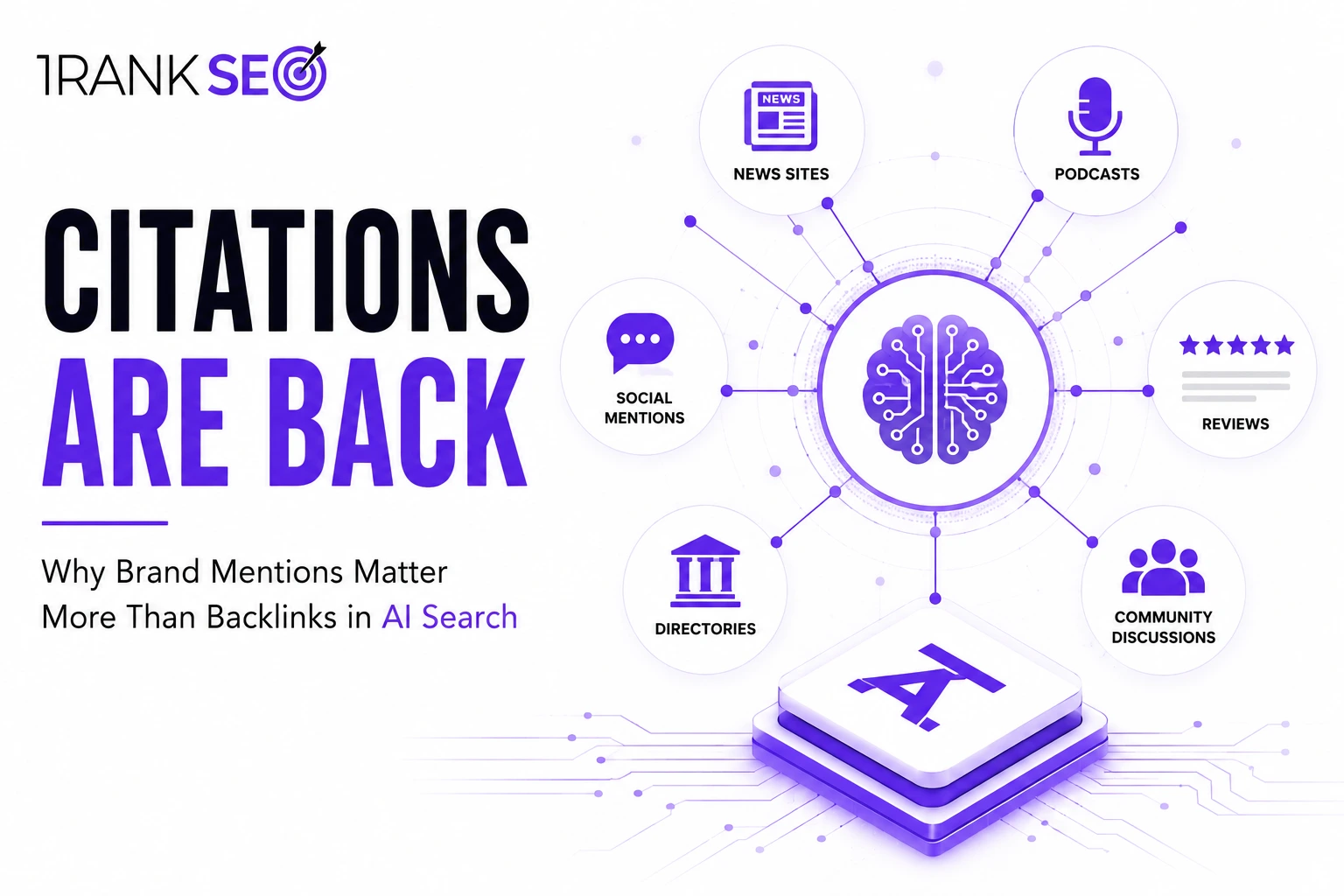
For years, SEO teams treated links like currency. The more high-quality backlinks a site had, the stronger its authority looked. That still matters. But AI search has changed the shape of visibility. Google, ChatGPT, Perplexity, and other AI engines do not only look for clickable URLs. They also need to understand who your brand is, what your brand is associated with, and whether other trusted sources talk about you in the right context.
The term we are looking for is Brand Mention in SEO context. It is different from a backlink, which is a link on another website that directs to yours. A brand mention, however, is when your business name appears somewhere online, even without a clickable link.
That might be a local news article, a podcast recap, a community forum, a chamber of commerce post, a “best agencies in Philadelphia” roundup, a Reddit discussion, a review, or a local business feature.
Backlinks still help. But brand mentions help search engines and AI systems understand your brand as an entity. Let’s talk about it.
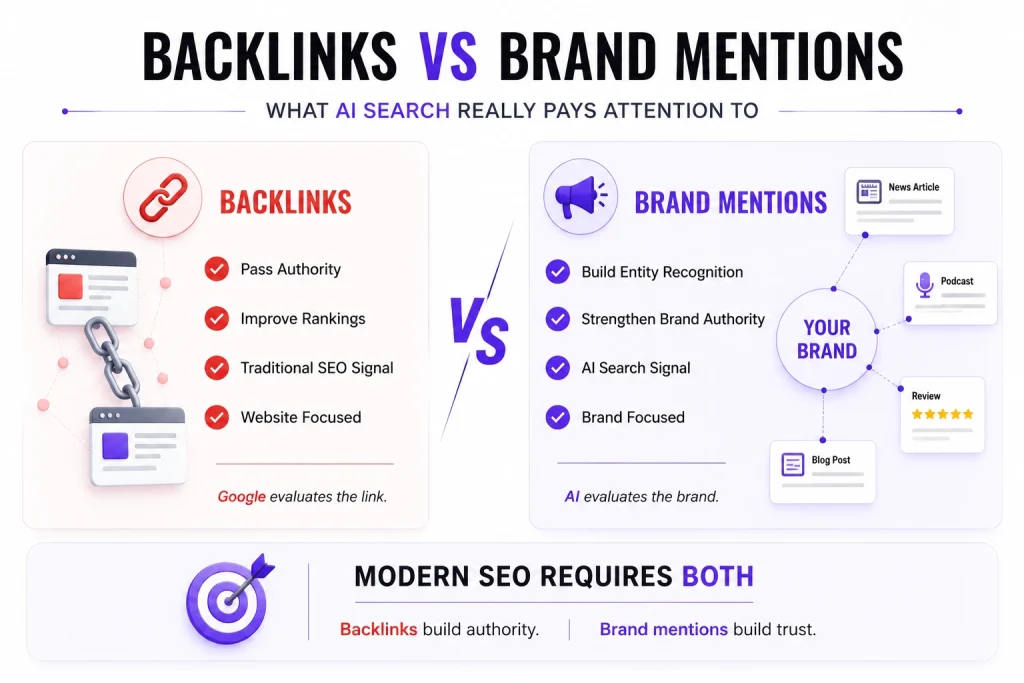
Backlinks vs. Brand Mentions: The Real Difference
A backlink says, “This information is connected to this (hyperlinked) website.”
A brand mention says, “This brand exists in this topic, location, market, or conversation.”
That difference matters because AI engines work heavily through entity recognition. They identify people, places, companies, products, topics, and relationships between them. Google’s Knowledge Graph, for example, is built around facts about “people, places, and things,” and Google says it uses that database to discover and surface factual information when useful.
So when your business is mentioned repeatedly near relevant terms, locations, services, and trusted sources, search systems get more clues about what your brand means.
For example:
- “1Rank SEO was featured in a Philadelphia small business marketing roundup.”
- “A local founder mentioned 1Rank SEO as a top SEO agency for service businesses.”
- “A community forum discussed 1Rank SEO in a thread about the best SEO help in Philadelphia.”
- “A local news site quoted 1Rank SEO on AI search trends.”
Only one of those may include a backlink. All of them can strengthen the brand’s digital footprint.
Why AI Engines Care About Entity Recognition
AI-generated answers do not behave like old-school search listings. They synthesize information from multiple sources, connect entities, and decide which names deserve inclusion in the answer.
Google’s AI features documentation says AI Overviews and AI Mode are part of Google Search and rely on normal crawling, indexing, and ranking systems. Google also advises site owners to focus on helpful, reliable, people-first content rather than special tricks for AI features.
But here is the practical SEO layer: if AI does not understand your brand clearly, it has fewer reasons to cite or mention you.
A website can say, “We are the best SEO agency.” That is self-claiming. AI systems tend to need corroboration. Independent mentions help create that corroboration because they show that your brand appears in the wider web ecosystem, not just on your own homepage.
This is where Brand Mentions vs Backlinks becomes less of a competition and more of a strategy. Backlinks help authority flow. Mentions help entity clarity.
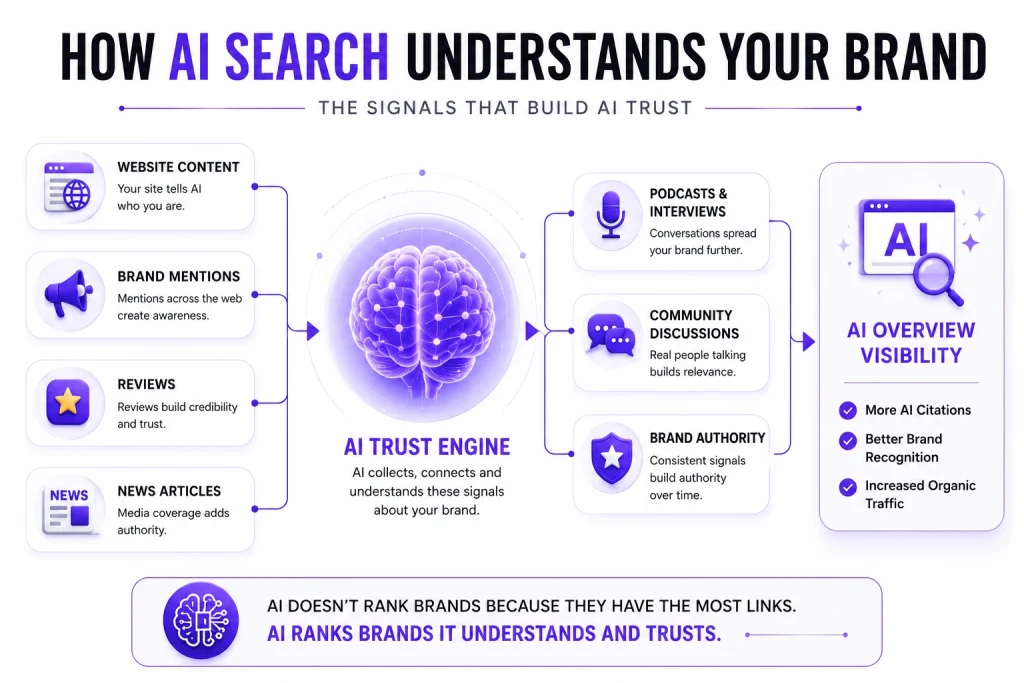
The New SEO Citation Is Often a Brand Mention
When marketers hear “citation,” they may think of academic citations or local directory citations. In AI search, the concept is broader.
A citation can be a source AI uses to support an answer. But before your brand becomes a cited source, AI systems need to understand what your brand is associated with. That association is built through repetition, context, and consistency across the web.
This means a Brand Mention in SEO can help in three ways:
- It reinforces your brand as a real entity.
- It connects your brand with specific services and locations.
- It gives AI more third-party context to evaluate reputation and relevance.
Google’s Search Quality Rater Guidelines also place heavy emphasis on reputation and E-E-A-T, including how a website or creator is viewed outside the site itself. The guidelines are not a direct ranking algorithm, but Google says they help evaluate whether search systems are working toward surfacing helpful, trustworthy results.
That is the little SEO goblin hiding in the machine: what others say about you increasingly matters because AI cannot rely only on what you say about yourself.
Local Digital PR: The Philadelphia Example
For local businesses, Local Brand Authority is becoming a serious advantage.
Imagine two SEO agencies in Philadelphia.
Agency A has a few backlinks from generic guest posts.
Agency B is mentioned in Philadelphia business news, local chamber content, nonprofit sponsorship pages, business podcasts, community event recaps, and local “best marketing agencies” discussions.
Which brand is easier for AI to understand as a Philadelphia SEO entity?
Agency B has a stronger local context. The brand appears near “Philadelphia,” “SEO,” “small business marketing,” “local business growth,” and “digital strategy” across independent sources. That creates a thicker entity footprint.
This is why local Digital PR matters. It helps your brand appear in the places AI engines may use to understand reputation, geography, and topic relevance.
Examples of local Digital PR that can support SEO:
- Quotes in business publication
- Guest commentary on local marketing trends
- Sponsorship mentions from local events
- Chamber of commerce profiles
- Podcast interviews with local founders
- Community partnerships
- Local award nominations
- Expert commentary in regional news
- Case studies with recognizable local clients
Some of these may earn high-quality backlinks. Some may only earn mentions. Both can be useful.
Co-Occurrence: The Keyword Signal Most Brands Ignore
Co-occurrence means your brand name appears near important keywords, topics, or entities often enough for search systems to connect them.
For 1Rank SEO, useful co-occurrence might look like:
- “1Rank SEO” near “Best SEO”
- “1Rank SEO” near “Philadelphia SEO agency”
- “1Rank SEO” near “AI SEO strategy”
- “1Rank SEO” near “local SEO for small businesses”
- “1Rank SEO” near “Google AI Overviews Optimization”
This does not mean stuffing keywords into press releases like a raccoon packing a suitcase. It means earning natural mentions in relevant contexts.
A local article titled “Philadelphia Businesses Prepare for AI Search” that includes a quote from 1Rank SEO creates a stronger association than a random backlink from an unrelated blog. The surrounding context matters.
That is co-occurrence at work: your brand name standing next to the phrases you want AI and search engines to associate with you.
Why Backlinks Still Matter, But They Are Not Enough
Backlinks are not dead. A strong backlink from a trusted, relevant website still helps SEO. Google’s systems still use many signals, and links remain part of how the web is discovered and evaluated. But a backlink-only strategy can become too narrow.
If your brand has links but no reputation signals, no local mentions, no expert quotes, no reviews, no discussion, no independent references, and no topical presence outside your own site, AI systems may struggle to see your brand as a trusted answer source. A modern link-building service should therefore include:
- Relevant backlinks
- Local citations and profiles
- Digital PR placements
- Expert quotes
- Unlinked brand mentions
- Review generation strategy
- Local authority building
- Co-occurrence planning
- Entity consistency across platforms
How 1Rank SEO Builds Brand Mentions for AI Search
At 1Rank SEO, we look at mentions as part of a broader authority system. The work starts by identifying what the brand should be known for.
For example:
- Who is the business?
- What services should AI connect it with?
- Which city or region matters?
- Which keywords should appear naturally near the brand name?
- Which third-party sources can reinforce the brand?
- What expertise should the market associate with the business?
From there, we build a strategy that may include Digital PR, local media outreach, citation building, content partnerships, expert commentary, link acquisition, review strategy, and brand visibility campaigns.
For a Philadelphia business, that might mean getting mentioned in local business content, sponsoring community events, earning quotes in regional stories, publishing insight-led articles, and building service pages that match what the brand is being mentioned for elsewhere.
This creates a tighter loop: the site says what the brand does, third-party sources confirm it, and AI engines gain more confidence in the entity.
The E-E-A-T Connection
Brand mentions support E-E-A-T because they help demonstrate that a business has recognition beyond its own website.
Google’s helpful content guidance says its automated systems aim to prioritize content that demonstrates experience, expertise, authoritativeness, and trustworthiness. Third-party mentions can support those signals when they show:
- real expertise
- local reputation
- community relevance
- professional recognition
- topical authority
- customer trust
- industry participation
This is especially important in competitive local SEO, where many businesses publish similar service pages. AI ignores generic content because generic content adds no new proof. Brand mentions give your SEO strategy more outside validation.
To Wrap Up, Your Brand Needs to Be Talked About
The future of SEO is not only about who links to you. It is also about who mentions you, where they mention you, and what your name appears beside.
A backlink can pass authority. A brand mention can build identity. Together, they help search engines and AI systems understand your business as a real entity with relevance, reputation, and topical weight.
If your brand only exists on your own website, AI has a thin file on you. If your brand appears across trusted local, industry, and community sources, the picture becomes clearer.
Ready to build authority beyond backlinks? Talk to us at 1Rank SEO about a Digital PR and Brand Mention in SEO strategy built for AI search, local authority, and the next era of organic visibility.
Ready to build authority beyond backlinks?
Talk to us at 1Rank SEO
about a Digital PR and Brand Mention in SEO strategy built for AI search, local authority, and the next era of organic visibility.