


Most dental websites do not fail because the clinic is bad. They fail because the website quietly blocks patients from booking, confuses Google about what the clinic offers, or leaves important pages sitting outside the index like unopened appointment reminders.
At 1Rank SEO, we recently reviewed 10+ Dental Care Websites in 2026 and found a pattern that kept showing up across very different practices. Some had beautiful designs. Some had strong treatment pages. Some were investing in ads. Yet their organic visibility and patient conversions were being limited by the same technical problems.
Our dental SEO audit uncovered three revenue-killing issues: poor Core Web Vitals on booking pages, missing dentist-specific schema, and page indexing problems.
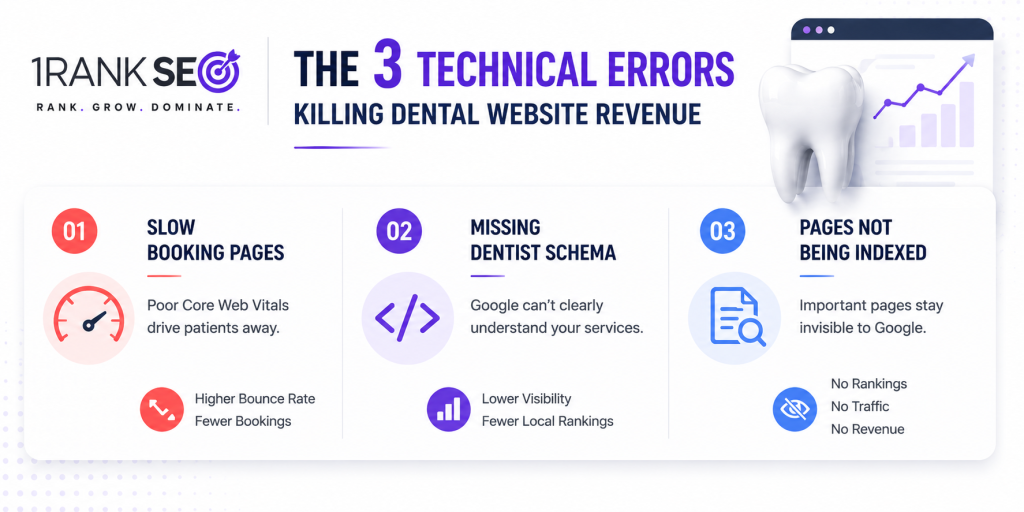
Here is what we found, how we diagnosed it, and how we fixed it. Let’s begin.
Problem 1: Slow Booking Pages Were Costing New Patient Leads
A booking page is not just another page. It is the final door before a patient becomes an appointment.
One dental clinic we audited had strong traffic from searches like “emergency dentist near me” and “same-day dental appointment.” The problem was not visibility or traffic. The problem was that the booking page loaded slowly on mobile, shifted while users were filling out the form, and had a laggy appointment button.
That matters because Google’s Core Web Vitals measure real user experience signals such as loading performance, responsiveness, and visual stability. Google replaced FID with Interaction to Next Paint, or INP, as a Core Web Vital in 2024, which means poor responsiveness can affect how Google evaluates page experience.
For this client, the booking page was carrying heavy scripts, oversized images, unnecessary form plugins, and third-party tracking tools that were firing too early. Patients were landing on the page, waiting, tapping twice, and leaving.
How 1Rank SEO Fixed It
We compressed and resized visual assets, reduced unused JavaScript, delayed non-essential scripts, simplified the booking form, improved mobile layout stability, and tested the page again after deployment.
A dental website can have great rankings, but if the booking page feels like it is moving through wet cement, revenue leaks out quietly. This is one of the most common Healthcare SEO technical errors we see in our dental SEO audits.
Problem 2: Missing Dentist Schema Made Treatment Pages Harder for Google to Understand
Another clinic had strong cosmetic dentistry content, but Google was not clearly associating individual pages with the procedures the practice actually offered. Their implant, Invisalign, veneer, and emergency dentistry pages had text, but no structured data helping search engines identify the business type, location, treatment categories, and service relationships.
Google’s Local Business structured data documentation explains that structured data can tell Google about business details such as hours, departments, and other business information. Schema.org also includes a specific Dentist type under LocalBusiness and MedicalBusiness.
For dental SEO, this matters. If a clinic offers implants, Invisalign, root canals, teeth whitening, and emergency dentistry, Google should not have to guess from loose page copy alone.
Example: The Invisalign Clinic That Looked Generic to Google
One orthodontic-focused dental practice had a polished Invisalign page, but the schema only identified the site as a generic local business. There was no Dentist schema, no Service schema for Invisalign, no FAQ Page schema for patient questions, and no clear connection between the provider, location, treatment page, and booking action.
To Google, the page had words. It did not have enough structured clarity.
How 1Rank SEO Fixed It
We added appropriate structured data, including LocalBusiness/Dentist markup, service-focused schema for procedure pages, FAQ schema where the page had visible FAQs, breadcrumb schema, and consistent name, address, and phone details.
We also made sure the structured data matched what was actually visible on the page. Google’s structured data guidance is clear that structured data helps Google understand page content, and the Rich Results Test can be used to validate eligibility and errors.
The result was a cleaner technical layer. The content said, “We offer Invisalign.” The schema helped say, “This dental practice in this location offers this specific service, with these related details.” Tiny code, but you get big lighthouse energy.
Problem 3: Important Dental Pages Were Not Being Indexed
The third major issue was page indexing. This one is brutal because a page that is not indexed cannot rank, no matter how beautiful or persuasive it is.
One multi-location dental client had pages for dental implants, emergency dentistry, family dentistry, and location-specific services. Several were marked as “Discovered, currently not indexed” or excluded due to canonical and noindex issues. In another case, older thin pages were indexed while newer, stronger service pages were not.
Google’s Page Indexing report explains issues such as pages blocked by robots.txt, URLs marked noindex, and other reasons a page may not appear in Search. Google also notes in its crawling and indexing documentation that websites or parts of websites may fail to be indexed for several technical reasons.
Example: The Implant Page Patients Never Saw
One implant dentistry page had strong copy, before-and-after context, FAQs, and a consultation CTA. But it had an incorrect canonical tag pointing to a general services page. Google followed the signal and treated the implant page as non-primary. That meant the clinic had invested in a high-value page that could not properly compete.
How 1Rank SEO Fixed It
We reviewed Google Search Console, checked canonical tags, cleaned up noindex errors, updated XML sitemaps, improved internal links, removed duplicate low-value versions, and requested reindexing for corrected pages.
We also connected high-value service pages from the homepage, service hub, location pages, and related blogs. Indexing is not only technical. Google also needs to see that a page matters within the site structure.
For dental practices, this matters because treatment pages often carry commercial intent. If your “dental implants” or “emergency dentist” page is missing from the index, your competitors are collecting the calls.
Why These Errors Hurt Dental Revenue
A dental website has one job: help patients find the right service and take the next step.
These three technical problems interrupt that journey:
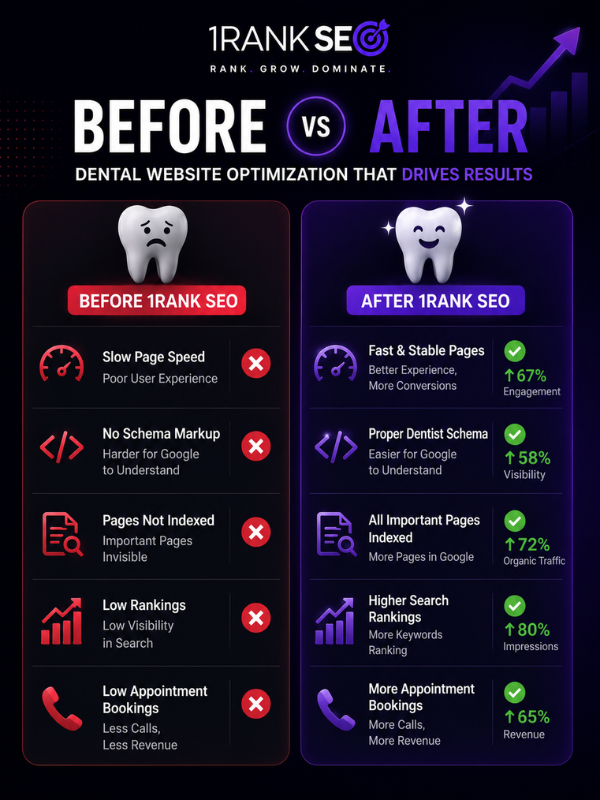
- Poor Core Web Vitals make patients abandon booking pages
- Missing schema makes services harder for Google to classify
- Indexing issues keep treatment pages invisible
Together, they reduce visibility, trust, conversions, and appointment volume. This is why a real dental SEO audit cannot only look at keywords. It has to inspect performance, schema, indexing, internal linking, service structure, mobile experience, and conversion paths.
How 1Rank SEO Approaches Dental Website Audits
At 1Rank SEO, our audit process is built around diagnosis first. We review:
- Google Search Console indexing data
- Core Web Vitals and mobile performance
- booking page usability
- schema and structured data
- service page visibility
- internal linking
- local SEO signals
- Google Business Profile alignment
- duplicate or thin content
- conversion friction
Then we turn the findings into a repair plan. And no, we are not talking about a 90-page PDF that nobody opens. A prioritized action roadmap based on what can improve rankings, calls, appointments, and patient trust.
To Summarize
The dental websites we audited needed technical clarity. In 2026, Local SEO for Dentists is about making sure Google can crawl the pages, understand the services, trust the business, and send patients to a booking experience that works. If your clinic is investing in SEO but not seeing enough appointments, one of these three errors may be sitting under the floorboards. Want us to check your site for these 3 errors?
GET YOUR