


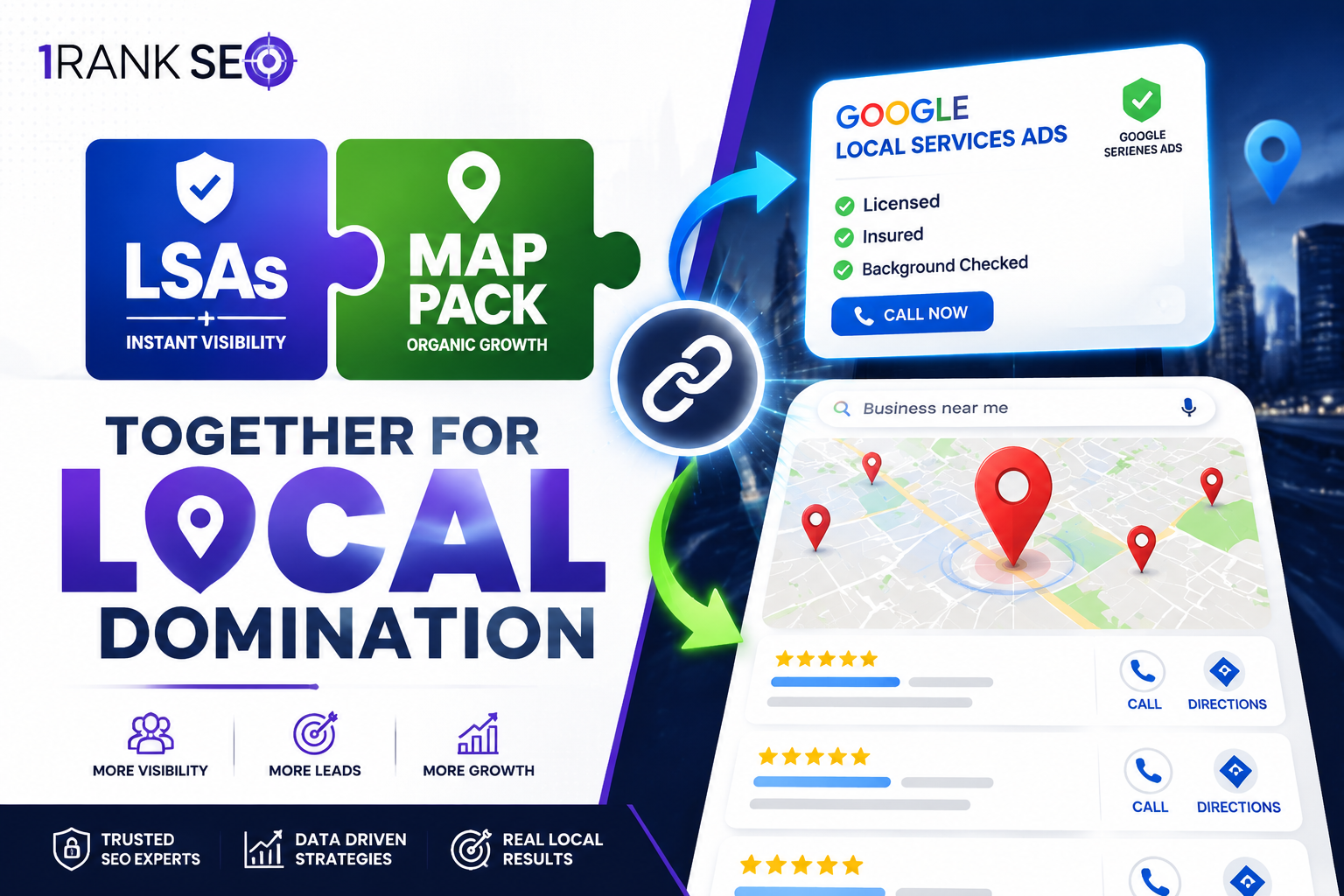
Local search is not what it used to be. A customer no longer types “plumber near me,” clicks the first result, and calls without thinking. Today, that buyer may see “Local Service Ads” at the top, scan the Organic Map Pack rankings, compare reviews, check the Google Business Profile, skim the website, and sometimes even look at AI-generated answers before making a decision.
That means local visibility no longer revolves around choosing paid ads or organic SEO. Now, it is more about making both work together.
For service-based businesses, especially in competitive markets, relying on only one side of the search page creates a serious revenue gap. Local Service Ads can generate fast leads, but they do not replace long-term Local SEO optimization. Organic Map Pack visibility can build trust and lower acquisition costs, but it may not give you enough instant exposure when a competitor is already paying for the top position.
At 1Rank SEO, we see local search as one connected system. A strong Google LSA strategy and strong Organic Map Pack rankings should support each other rather than compete for budget. Let’s unpack local search in detail.
The Problem: “Local Buyers Do Not Search in a Straight Line”
Local buyers are often in a hurry. They may have a leaking pipe, a broken garage door, a legal issue, an HVAC problem, or a medical appointment. They are not casually browsing like the rest of us. They are looking for a business they can trust quickly.
But quick does not mean careless.
Most local buyers compare signals before calling. They look at who appears first, who has strong reviews, who looks active, who has a complete profile, who answers clearly, and who seems credible. That decision can happen in under a minute, but it still involves multiple trust points.
This is where many local businesses lose revenue. They invest in Pay-per-lead Google ads but neglect Google Business Profile management. Or they work on organic rankings but ignore Local Service Ads while competitors capture calls at the very top of the page.
What they really get is fragmented visibility. The business appears in one section of Google but disappears in another. To the customer, that can create doubt. For competitors, it creates an opportunity.
Why Relying Only on Local Service Ads Leaves Money on the Table
Local Service Ads are powerful because they place verified service providers in a high-visibility area of Google Search. They are built for lead generation, and businesses pay when qualified prospects contact them through the ad.
That sounds ideal, but LSAs are not a complete local strategy on their own.
First, Local Service Ads depend heavily on profile quality. Your reviews, response time, service categories, business information, photos, and verification signals can influence performance. If your Google Business Profile is weak, outdated, or inconsistent, your LSA performance can suffer.
Second, paid visibility stops when budget, bidding, or eligibility becomes a problem. If your spend is limited or your competitors increase bids, you may lose top placement. If you depend only on paid leads, your pipeline becomes more vulnerable.
Third, some customers still scroll past ads and compare organic results. A buyer may see your LSA, then check whether your business also appears in the Map Pack. If you are visible in both places, it reinforces confidence. If you only show as an ad but are missing from organic local results, the buyer may wonder why.
Paid ads are great for creating exposure, but organic trust helps turn that exposure into calls.
Why Relying Only on Organic Map Pack Rankings Also Creates a Gap
Organic Map Pack rankings are essential for the local authority. They help your business appear when customers search by service, location, and intent. Strong rankings can reduce dependence on paid traffic and bring in leads without paying for every contact.
But organic alone also has limits.
In competitive service categories, LSAs often appear above the Map Pack. That means a competitor can capture attention before the customer even reaches the organic section. Even if your Map Pack ranking is strong, paid competitors can still win urgent calls from buyers who want the fastest option.
Organic rankings also take time. Local SEO optimization requires ongoing work: review growth, content improvements, citations, technical SEO, GBP updates, service pages, location relevance, and authority building. It is one of the strongest long-term assets a local business can build, but it should not be expected to carry every lead source alone.
The strongest local businesses do not treat LSAs and Map Pack rankings as separate campaigns. They make them work as one system.
The AI Search Factor – Why Local Visibility Now Goes Beyond the Map Pack
Google’s AI Overviews and AI search experiences are also changing how users discover information. AI-generated results often pull from multiple supporting sources, compare information, and surface links that help users explore further.
For local businesses, this makes content quality more important. Generic pages that repeat the same basic service descriptions as every competitor are less useful. Search systems are moving toward content that adds real value, answers specific questions, and gives users something they cannot find everywhere else.
This is where “Information Gain” matters. In simple terms, information gain means adding something new and useful to the web instead of publishing copied, thin, or recycled content. For a local service business, that can include neighborhood-specific service insights, before-and-after project notes, pricing factors, seasonal service advice, emergency checklists, local regulations, FAQs based on real calls, and expert explanations from the company’s own experience.
AI Overviews also make technical clarity more important. Structured Data and Schema help search engines understand business details, services, reviews, locations, FAQs, and page meaning in a machine-readable format. Schema alone does not guarantee rankings, but it supports a cleaner, more understandable search presence.
The Solution? A Unified Local Domination Strategy
By now, you understand the complex soup that search has become. However, this is where an experienced brain that understands the current dynamics of marketing helps. At 1Rank SEO, we build local campaigns around a simple principle, and that is every search result section should support the next one.
Your Local Service Ads should create fast lead opportunities. Your Organic Map Pack rankings should build trust and long-term authority. Your Google Business Profile should strengthen both. Your website should support conversions, organic rankings, and AI visibility. Your reviews should improve buyer confidence across paid, map, and organic touchpoints.
How 1Rank SEO Synchronizes LSAs and Organic Map Pack Rankings
A unified strategy starts with the Google Business Profile. 1Rank SEO reviews the profile for accuracy, service categories, business hours, service areas, photos, products or services, appointment links, review strategy, and keyword relevance. This strengthens the organic Map Pack foundation while also supporting the trust signals that matter for LSAs.
Next, the Google LSA strategy is built around lead quality. That means reviewing job categories, service areas, bidding approach, lead disputes, response time, call handling, and weekly performance trends. Poor-quality leads waste budget. Missed calls damage opportunity. Weak service targeting attracts the wrong customer. A strong LSA campaign needs active management.
At the same time, Local SEO optimization works in the background to build durable visibility. 1Rank SEO develops service pages, location pages, internal links, citations, review growth systems, and content that supports both rankings and conversions. Our agenda is to help the business appear when buyers search from different neighborhoods, use different service terms, or compare several providers.
The review strategy connects both systems. Reviews influence trust, clicks, calls, and buyer confidence. A business with strong reviews in both paid and organic areas has a better chance of being chosen than a business that only appears once.
Building Content That Helps Google and Buyers Understand the Business
Many local websites fail because they say the same thing as everyone else. “Reliable service,” “experienced team,” and “affordable pricing” are not enough.
1Rank SEO focuses on content with real information gain. That means adding useful details such as service process, local issues, common repair causes, response expectations, material options, project timelines, service area differences, and practical customer education.
For example, an HVAC company should not only have a page that says “AC repair in Dallas.” It should explain common AC problems in that climate, what homeowners should check before calling, when a repair may not be enough, how emergency service works, and what customers can expect during a visit.
That type of content supports organic rankings, improves conversion, and gives AI-driven search systems clearer information to work with.
Structured Data and Schema: The Technical Layer Local Businesses Should Not Ignore
Local domination is a mix of content, ads, and technical structure. 1Rank SEO uses Structured Data and Schema to help search engines understand the business more clearly. This may include LocalBusiness schema, service schema, FAQ schema, review-related markup where appropriate, organization details, geographic information, and consistent name, address, and phone data.
Schema should match visible page content. It should not be used to stuff keywords or mark up claims that users cannot see. When done correctly, it supports clarity, improves eligibility for enhanced search features, and helps Google connect the business to relevant services and locations.
To Summarize
Local Service Ads can bring fast visibility. Organic Map Pack rankings build long-term trust. Google Business Profile management connects the two. Helpful content supports search, AI visibility, and buyer confidence. Structured data makes the entire presence easier for search engines to understand.
When these systems work separately, businesses often overspend in one area and underperform in another. When they work together, every part of the search page reinforces the same message: this business is visible, trusted, active, and ready to help.
Ready to dominate the Local Map?
Talk to us at 1Rank SEO
That is local domination. Stop splitting your marketing budget down the middle. Let 1Rank SEO build a unified Local Domination strategy for your business today.