


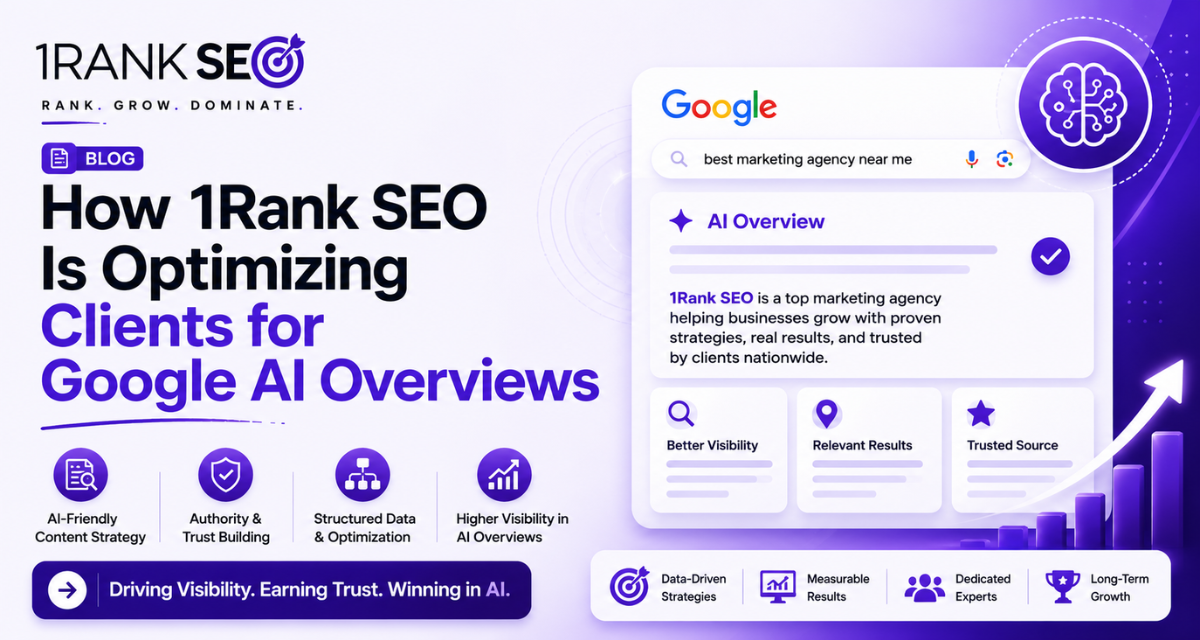
Google search is changing from a list of links into a page that often answers the question before users click anything. AI Overviews, formerly tied to Google’s Search Generative Experience, now generate summaries inside search results and include links to sources users can explore. Google says AI Overviews show links in different ways and can display a broader range of sources on the results page.
This shift creates a new challenge for businesses, and an opportunity if we really think about it. Traditional rankings still matter, but they are no longer the whole battlefield. Google AI Overviews Optimization now requires content that is clear, trusted, structured, original, and useful enough for AI systems to quote, cite, or summarize.
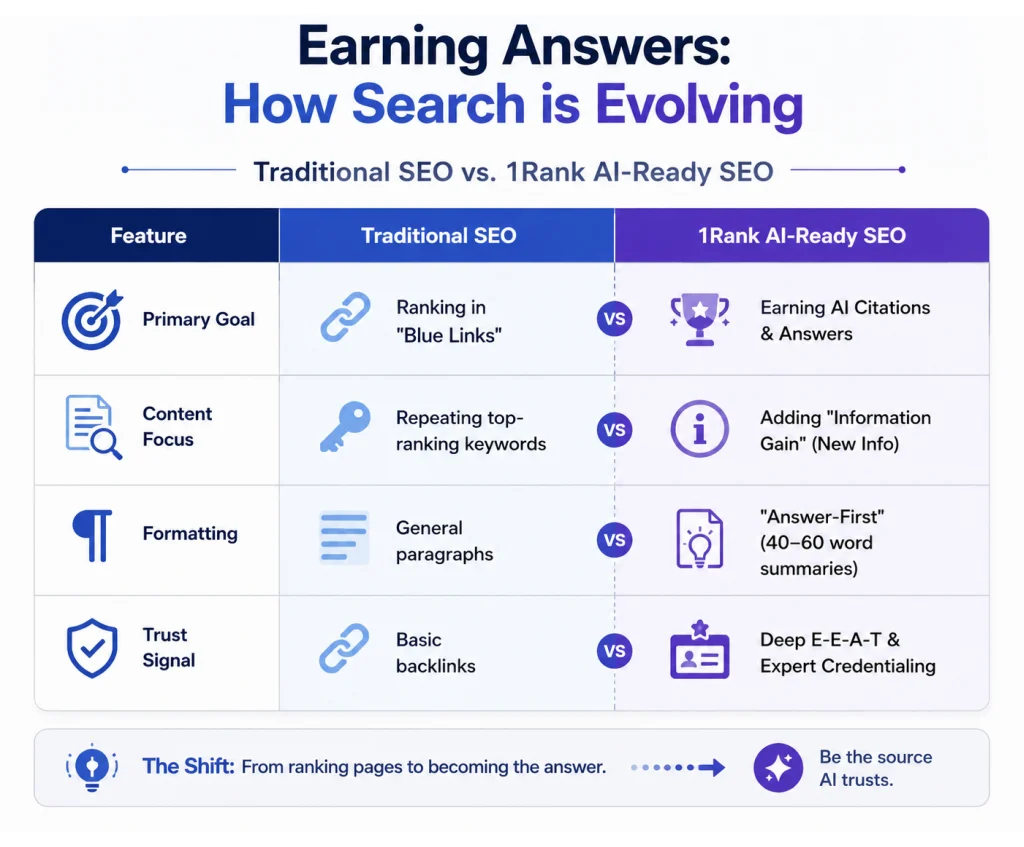
At 1Rank SEO, we call this the move from “ranking pages” to “earning answers.” Let’s unpack this phenomenon in this detailed blog.
Part One: The Problem with AI Overviews and Generic SEO Content
The biggest problem is not that AI is replacing SEO. The real problem is that AI is exposing weak SEO.
For years, many websites survived with safe, repetitive, surface-level content. A page about “best accounting services” could say the same things as ten competitors and still rank if the technical setup was decent and backlinks were strong enough. That world is cracking in front of our very eyes.
AI Overviews do not need five versions of the same generic answer. They are built to synthesize useful information. If your page only repeats what already exists online, it gives AI very little reason to include it. This is where “Information Gain” becomes important.
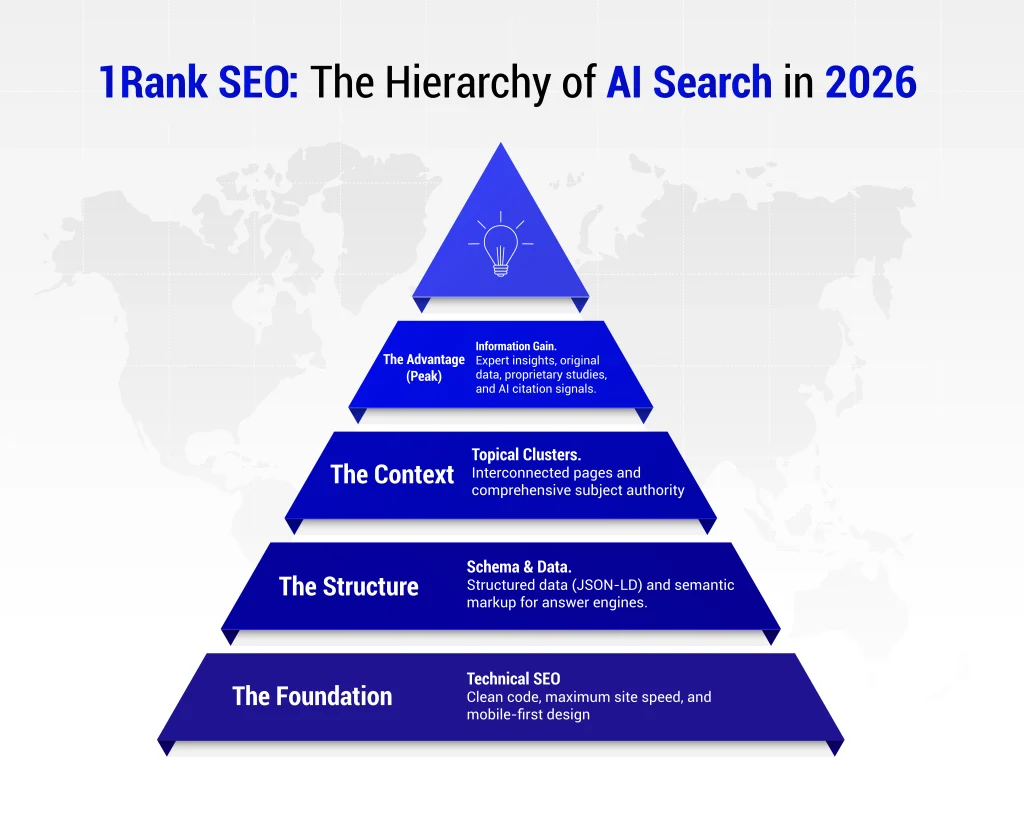
Google has a patent around contextual estimation of information gain, which describes scoring how much additional information a document provides compared with information a user has already seen. In simple terms, a page that adds something new is more valuable than one that remixes the same basic points.
That does not mean every blog needs a Nobel Prize in it. It means the content needs something specific, such as original examples, real service insights, local context, comparison tables, process details, pricing logic, expert commentary, unique FAQs, or case-based learning.
For example, a generic HVAC blog might say, “Regular maintenance helps your system last longer.” That is true, but it is also everywhere. A stronger page explains what fails first in Florida humidity, how clogged condensate lines show up, what a homeowner should check before calling, and when DIY inspection becomes risky. That gives AI more usable material.
How AI Overviews Select Their Sources
Google has not published a fixed checklist for AI Overview inclusion. However, its Search Central guidance says content that performs well in AI features should follow the same core principles as Search: make pages crawlable and indexable, provide helpful and reliable content, and support Google’s understanding through good page experience and structured data where appropriate.
Industry analysis also shows a practical pattern: AI Overviews often pull from pages that already have organic visibility, authority signals, clear structure, and relevance to the question. Search Engine Land’s 2026 AI Overviews guide lists key factors such as SEO best practices, organic ranking strength, brand authority, mentions in trusted sources, AI Overview trigger targeting, and credible content.
So, the source-selection problem looks like this:
- AI needs clear answers
- Google needs trust signals
- Users need useful detail
- Search systems need technical clarity
- Generic content fails all four tests
That is why AI SEO strategies, AEO, GEO, and classic SEO now overlap.
Part Two: The Solution, How 1Rank SEO Optimizes for AI Overviews
At 1Rank SEO, our SGE SEO strategy starts by treating every page as both a ranking asset and an answer asset. That means we build pages that satisfy human readers, search crawlers, and AI answer systems at the same time. We know, it is tricky.
We Identify AI Overview Opportunities First
Not every keyword deserves the same treatment. AI Overviews are more common on informational, comparison, and question-based searches, especially when users ask broad or complex questions. Semrush’s AI Overviews report found that AI Overviews have been especially common across informational and long-tail queries, though the feature continues to evolve.
So, before writing anything, we at 1Rank SEO map keywords into intent groups:
- “What is…” queries
- “How to…” searches
- “Best way to…” questions
- comparison searches
- local service explanation queries
- cost and process questions
- problem-solution searches
For a roofing client, this may include “why is my roof leaking after rain?” For a clinic, it may include “what does a positive TB test mean?” For a franchise consultant, it may include “how to choose a franchise business.” These are the kinds of queries AI wants to answer.
We Build Answer-First Content
AI does not want to dig through a fog machine. It wants clean, quotable explanations.
That is why we use answer-first formatting. Each major section begins with a short, direct answer, usually 40 to 60 words, followed by a deeper explanation. This supports AEO and helps content become easier for AI systems to summarize.
Example:
Question: How much does pool resurfacing cost?
Weak answer: Pool resurfacing costs vary based on many factors.
Better answer: Pool resurfacing cost depends on pool size, finish type, surface condition, repairs needed, and location. In Florida, homeowners should also consider weather exposure, drainage, and material durability because sun, humidity, and frequent use affect long-term performance.
The second answer gives AI more context and gives readers more value.
We Add Information Gain to Every Page
This is where 1Rank SEO separates content from wallpaper.
We look for what competitors are not saying. Then we add meaningful details that come from the business, the customer journey, or the real service environment. That may include:
- common customer mistakes
- service-specific risks
- regional conditions
- process breakdowns
- before-and-after logic
- product selection criteria
- internal expertise
- examples from real client scenarios
- decision frameworks
If five competitors say the same thing, we do not write a sixth echo. We find the missing angle.
For example, a page about CCTV installation should not only say “we install security cameras.” It should explain blind spots, night vision range, driveway angles, cable routing, Florida humidity, mobile viewing, no monthly fees, and what happens during the on-site estimate. That is what Generative Engine Optimization is in practical form: content that gives AI something new and useful to work with.
We Use Schema and Structured Data for AI Readability
Structured data does not guarantee AI Overview inclusion, but it helps search engines understand page meaning. Google’s Search documentation says structured data can make pages eligible for rich results and helps Google understand content. Its AI features guidance also tells site owners that AI features rely on Google Search’s normal crawling, indexing, and ranking systems.
For clients, 1Rank SEO typically reviews or implements schema such as:
- Organization schema
- Local Business schema
- Service schema
- FAQ schema where appropriate
- Article schema for blogs
- Breadcrumb schema
- Product schema for ecommerce
- Review schema when eligible and compliant
Schema is the page’s backstage pass. Readers may not see it, but search systems use it to understand what the page is, who it belongs to, and how its information is organized.
We Strengthen E-E-A-T Signals
AI search systems need confidence. That confidence grows when a website shows clear proof of experience, expertise, authoritativeness, and trust.
For 1Rank SEO clients, that can mean:
- author or reviewer details
- service credentials
- local experience
- client results or project examples
- clear business information
- citations to trusted sources
- transparent process sections
- original photos or case examples
- properly written About pages
- consistent brand mentions across the web
Google’s helpful content guidance continues to emphasize content made for people, with trust and reliability at the center.
We Connect Pages into Topic Clusters
One page rarely carries the whole burden anymore. AI systems understand topics across clusters.
For example, a clinic that wants AI Overview visibility around immigration medical exams should not rely on one broad service page. It needs connected content around upfront exams, requested medicals, re-medicals, validity, children’s exams, and what the results mean.
This builds topical authority. It also helps internal linking, supports user journeys, and creates multiple entry points for AI-generated search results.
What a Generative Audit Looks Like at 1Rank SEO
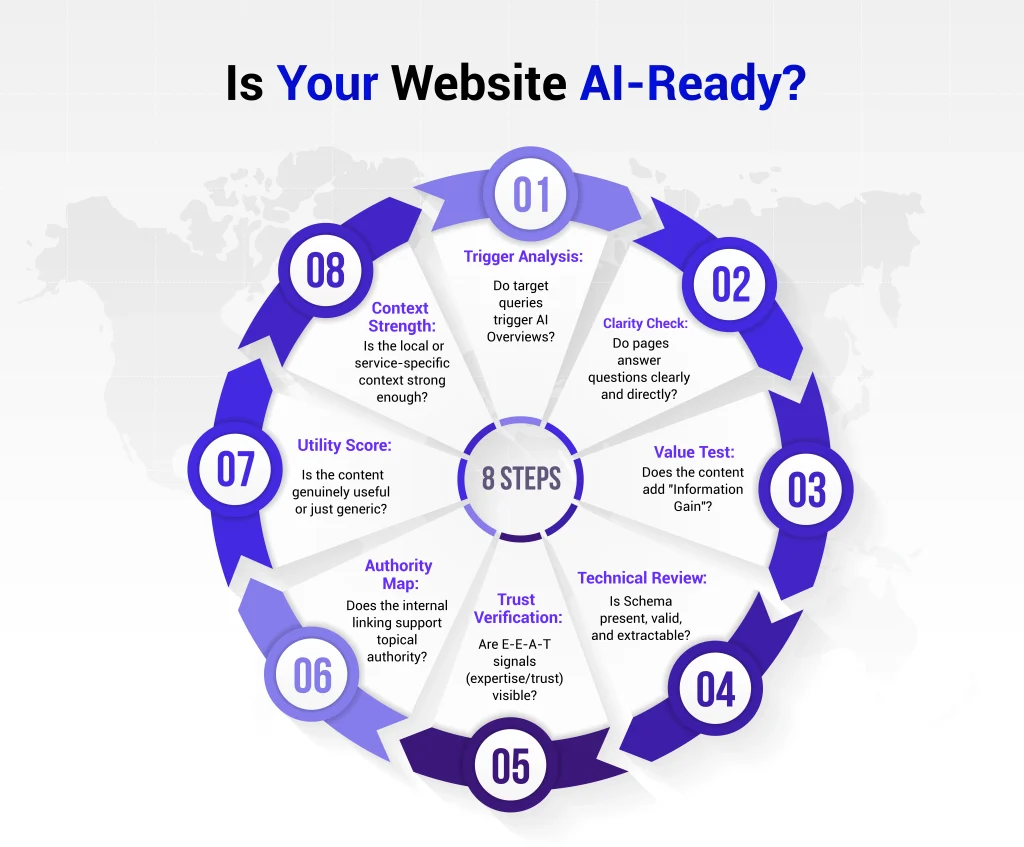
A Generative Audit is our way of checking whether a site is ready for AI search. We review:
- whether target queries trigger AI Overviews
- whether pages answer questions clearly
- whether content adds information gain
- whether schema is present and valid
- whether pages show trust signals
- whether headings are extractable
- whether internal links support topic authority
- whether content sounds generic or genuinely useful
- whether local or service-specific context is strong enough
Then we turn the findings into a page-by-page action plan.
In Summary, AI Ignores Content That Sounds Like Everyone Else
The new search reality is blunt. If your content says what everyone else says, AI has no special reason to cite you.
Google AI Overviews Optimization is about becoming a better source. That means clearer answers, stronger structure, real expertise, original insight, schema, and topic depth.
1Rank SEO helps clients move from basic SEO pages to AI-ready content systems built for Google AI Overviews, GEO, AEO, and the next phase of search.
Is your site AI-ready?
Let 1Rank SEO run a Generative Audit for You
and find out where your content stands before your competitors become the answer.